Some farm animals are classified as livestock. For us that included cattle, pigs, sheep and chickens. Those animals were raised for income and food. The others were pets - dogs and cats. Both had jobs to do.
Cats
The cats controlled rodents. They hunted mice, rats, voles, gophers and rabbits. The latter are not rodents, but they can all be informally categorized as “varmints.” I don’t remember that we had a problem with rodents, probably because the cats were so good at their job.
The cats were also pets, though they lived outside because Mom would not allow animals of any kind in the house. Except for the winter, the cats were usually near the house. Sometimes there were up to 20 cats, but normally the amount was about half that. The cats were not spayed or neutered or declawed or altered in any way. We fed them table scraps and leftovers, and the rest of their nutritional needs they took care of on their own via their able hunting skills.
| Many of our cats were tabbys. We called them "Tiger Cats" |
The cats knew the evening chore routine very well, so they were waiting in the barn when Dad arrived with the milk pail. They congregated by their feed pan about six feet from the cow, waiting for the warm milk that was soon to come. Frequently Dad squirted milk right into the cats mouths. If any of us children were there, we asked Dad to do it because it was fun to watch. Dad turned the teat toward the cats and squeezed. He didn’t have to aim perfectly because the cats were ready. They quickly placed themselves so that the stream went right into their open mouths. Dad was the pitcher and the cats were error-free catchers.
It seemed that there was always a derelict fry pan, handle broken off, there in the barn. It became a cat feeder. When he was done, Dad poured about an inch of milk into the pan whose rim had become crowded with meowing cats. They quickly settled in and began companionably lapping it up.
I don’t remember the names of any cats except Obno and Fluffy, though I can see the variety of colors and sizes. “Obno” was short for “Obnoxious.” Fluffy was Jill’s favorite. She was a long-haired gray and white cat.
I remember one really frigid winter when all outdoor animals were having a tough time. The cats were in the hog house and we had given them some bedding. I think it was old blankets and straw. Still, it was difficult. There was some grain spilled under the yardlight in the center of the yard between the barn and the house. It happened every harvest. This year, because of their hunger, rabbits were congregated there under the light eating the grain. On occasion, we shot one for the cats to eat. Once I was the shooter.
I stepped just out of the house and stood next to the door with the .410 shotgun tucked against my shoulder. I didn’t aim at a particular rabbit because they were clustered so close together. I pulled the trigger. I was surprised to see a rabbit fly into the air. I thought one would just fall over dead. Needless to say, the rabbits scattered. I picked up the one I’d killed and brought it into the hog house. The cats pounced on it; time to sate their hunger.
Some summers, for no known reason, distemper ravaged our cat population. That was always so sad. The first symptom was a crust around the eyes. The cats rapidly deteriorated from there. It was a slow, wasting disease. Usually Dad ended their suffering.
One of our well-learned lessons was that we are ultimately responsible for the animals we own. That included maintaining their well-being. We were never to allow animals to suffer needlessly. That meant that those dying cats had to be put out of their misery. One summer, in the midst of a distemper outbreak, I decided I would try to take care of two cats who were in terrible condition. I didn’t want to see them suffer, and I was feeling compassion for Dad always having to do that sorrowful task.
The cats were young, maybe six months old. One was black, the other black and white. I decided to take the black one first. I think Dad usually drowned them, but I couldn't do that. I took the 22 rifle with me, and a paper sack. I put those items in Old Red, along with the black cat, and drove out to the landfill in the pasture. My plan was to shoot the cat, put it gently in the bag, and place it in the landfill.
As I drove out to the place, I felt sad, but really wanted to do it, because it was a kind thing to do, both for the cat and for Dad. I got the rifle out of the pickup, put a couple of shells in it, then lifted out the cat. The cat was very tame and friendly. It wound around my legs, rubbing against them, as cats will do. I stood above it, rifle against my shoulder, looking down, tears beginning to fall. I said, “You’ve got to get away from my feet so I can do this before I can no longer see.” Just then there was a moment when he stood between my feet. I pulled the trigger.
Thankfully the cat dropped immediately, shot through the head. It was dead, hardly any blood. That was such a relief. It would have been terribly difficult to shoot again.
I burst into tears, crying, gulping, sobbing. I got out the paper grocery bag and carefully laid the cat in it, closing up the top, while tears poured down my cheeks. I walked the few steps over to the landfill and placed the bag there. I went back to Old Red and drove. Something broke open inside me, and I could hardly see through the tears.
I don’t cry much, or often, but I must have cried for everything I’d ever had to cry about. My nose ran, tears poured down, and I couldn’t stop. I didn’t try to. I just drove slowly around the pasture until finally I was cried out. My face and mouth and eyes hurt from all the sobbing, all the tears. I must have been dry by then.
Mom knew what I had done, so when I got back to the house she was waiting for me. I’m sure I didn’t look very good. I took the rifle into the entry way and hung it on the rack. I said, “I can’t do the other cat. I’m never doing that again.”
Dogs
Our dogs were nearly always herding dogs, and we children became their flocks, lucky for us. The first dog I remember was Tag, though I believe we might have owned a little Pomeranian named Taffy when I was very small.
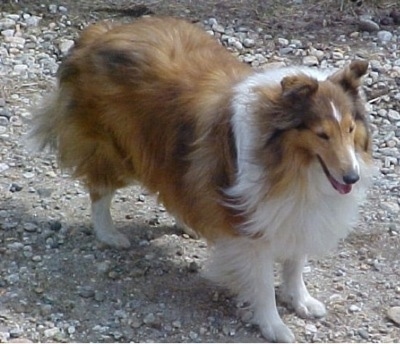 |
| Rough Collie |
But this day, so wrapped up were we, that we didn’t realize the cattle had been drifting our way as they grazed. We didn’t notice anything until they started running toward us. We were terrified, running as hard as we could to avoid being trampled in a stampede!! I remember looking up and seeing that the fence surrounding the pasture was too far away, and I, being the youngest, was too slow! I wasn’t going to make it! Suddenly, just like Lassie rescuing Timmy, here came Tag! He ran past us toward the cattle so that they turned away and stopped. Tag saved us! He saved us! That’s what we breathlessly told Dad and Mom when we got back up to the house.
They were really bubble bursters, telling us that the cattle were probably curious and coming to see what we were, and what we were doing, but no threat whatsoever. I know now that was likely true, and we were probably in no danger at all. But our own imaginative rendering was so much more exciting!
In fact, Tag’s fierce willingness to protect us did eventually result in his demise. Occasionally an outbreak of rabies went across the area, and we saw rabid skunks. Rabies, if not treated quickly, is fatal to humans. At that time the treatment consisted of a series of very painful injections into one’s stomach. Rabies is transmitted via the saliva of the infected animal through a cut or scratch to the receiver.
On an occasion, a skunk got too close to the house, and Tag attacked it. Normally, a dog would avoid such a creature due to the terrible smell and instinctual sense to avoid a sick animal. But Tag truly did behave in a heroic way by attacking that skunk regardless of the risk to himself. He killed the skunk, and he was bitten. He was such a good and loyal family pet. We didn’t want to see him killed. Dad put him in a chicken house that locked, and fed and watered him there. If he had contracted rabies, symptoms would appear in a week or less.
The symptoms did appear. Dad shot him. It was very difficult for Dad, because he always attached to the dogs, as they did to him. I seem to remember Dad being very quiet for a few days. As a family, we rarely talked about things, so I don’t know with a certainty, but my observation was that Dad was very much saddened by losing Tag. I have always respected Dad for the care he showed for our pets.
We had a non-collie or two after Tag. One was a Weimerainer. They are short-coated, brownish/grayish hunting dogs. He was an aberration in our dog choices. The one I remember best after Tag was Tip, a black and white border collie. (You can see that Dad went in for short dog names.)
We got Tippy as puppy. Border collies are the top dog when it comes to intelligence, though poodles are a close second. Again, we became his herd. Unfortunately, Tip was never trained to herd, so whatever he accomplished was by instinct only. He was always eager to help whenever the cattle were handled.
| Border Collie |
Tip liked to ride in the back of Old Red and accompany us to the field or the neighbors, wherever we might have been going. We did not include him if we were going very far though.
Tippy served us well and loyally for many years, but eventually age began to creep up on him. His eyesight was failing, his hips were painful, and he became less patient. Then he began nipping at grandchildren. The consensus among the family was that, in kindness to Tip and for the grandchildren's safety, it was time to let him go.
Sister Tammy and I decided that we could take him into the vet in Miller to be put to sleep. I drove the big ‘66 Merc, while Tammy rode in the backseat with Tip. Tip had never been inside a car, and so was scared. Then cars met us on the highway and rattled him. His bark had become a deep bass after all these years, and he barked frequently on the way there. Tammy did her best to soothe and comfort him amidst her sadness.
We arrived at the vet’s office and Tip was just shaking. Tammy didn’t want to come in, understandably, so I carried Tip in. He was too scared, trembling too hard, to walk. He had never been in an environment of so much noise, such strange smells. I felt very sad for him, as did Tammy.
The vet was expecting us, so I carried Tip into the back room. The vet had a long needle on a syringe with a clear liquid in it. I put Tip down on the floor, where he did not move. My heart went out to him. The vet asked, “Do you want to go now?”
I looked at good ole Tip, anxious and alone, and knew I had to stay with him. I shook my head and knelt down next to him. I patted him and talked gently to him. The vet inserted the needle, pushed the plunger slowly, and within seconds, Tip simply relaxed under my hand. He was dead, it was over. The vet asked if I wanted the body. I looked down and knew that was no longer Tippy. I thanked the vet, told him no, and walked out to Tammy.
I told Tammy that it was done, and that it wasn’t bad. It had been quiet, the vet had been kind and thoughtful, and Tippy had gone easily. Still, we were sad, didn’t say a lot, and drove back home.
Baby Lambs
Baby lambs were the most fun! They were very cute, small, soft, fuzzy and smelled good. They were easy to pick up and they nibbled at us.
Lambing time was usually in March. Snow storms were likely, and sheep are not good at self-preservation, so we always brought them in to the barnlot next to the barn. When a ewe (female sheep) was near lambing, or as soon as she was discovered with a new lamb, they were brought into the barn. The barn was so cozy in lambing season. It was warm, redolent with the smell of baby lambs, and full of cats, dogs and sheep.
| Ewe |
The ewes were protective mothers, and saw us as a potential danger, so they didn’t like us to come near. For us children, it was a favorite thing to do. That’s because, as we came nearer the pen, the ewe snorted and stomped one of her front feet. That was to frighten us away. If we kept coming she faked a rush at us. That fake was just a step or two. We thought it was great fun making her stomp like that.
Another favorite involved the lambs in the bigger group. We liked to grab a lamb by a hind leg. The sheep were annoyed, but not panicky when we did that. The lamb jerked its leg very rapidly, making the child jerk rapidly too. The key was to make an “Ahhhhhhhh,” sound as the lamb jerked. Due to the jerking, the Ah came out staccato, “Ah-h-h-h-h-h-h-h-h.” We thought that was hilarious!
| 2 -3 month old Lambs |
Pigs
I never liked pigs. They scared me. Pigs are omnivorous, and I saw them eat various kinds of offal, like chicken guts left from our preservation. There were always stories about someone being attacked and dreadfully cut up by their pigs. Pigs were the first livestock we stopped raising. I only have one fun story about pigs.
I’ve seen every animal on the farm born and it is really wonderful, gross, and smelly. I was sometimes awed, but only pig birth made me laugh aloud.
The sow lays on her side. Because of the way pigs are built, there was a drop of perhaps four inches from her opening to the wooden floor of the pen. The average baby pig I saw was about six inches long at birth. Sows always have multiple births unless something is drastically wrong. Six or eight babies was a pretty common litter.
| Sow and piglet |
Cattle
Most of the time we had Herefords. Us children developed a loyalty to Herefords because Dad said they were best. That was enough for us. Dad also said Angus were not as good. So we didn’t like Angus cattle. (I still like Herefords best.)
| Cow and Calf |
One of Dad’s school chums raised Gelbveih, so Dad got the bull there. We called the bull “Esche,” for Dad’s classmate, Duane Eschenbaum.
We had a Hereford bull whose official breed name was “Crusty Domino.” Bulls can be irracisible, but Crusty was the most relaxed, tamest bull I’ve ever had any experience with. In the summer there is a time when the bull is shut away from the cows so that they won’t be having calves in the dead of winter. We had the “bullpen”, against the side of the barn. It was sturdily made of two by eight planks. Most of our bulls didn’t really like living in the bullpen. Some were really a problem because they were so intent on getting back to the pasture and the cows.
| Could be Crusty Domino |
It was most fun when he was lying down. We grabbed Crusty's horns, trying to jerk his head around. Keep in mind this beast weighed more than a ton, with thick, heavy, strong neck muscles. We did not move him an inch. When Crusty got annoyed with our antics, he twitched his head a bit. The child holding the horn went flying. We thought all that was hilarious, and vied for the opportunity to be thrown.
Crusty was so big and soft. Sometimes we laid on top of him when he was lying on his side. His skin was warm, his rhythmic breathing gently raised and lowered us. It felt comfortable, safe and cared for to me. Crusty was a good bull.
Dad sold one bull and bought another every other year. That was to avoid inbreeding with heifers (young cows) that were daughters.
Two or three times I year we had to work cattle. It might have been to dehorn, castrate, and innoculate calves in the fall. It might be to sort cattle in the summer, getting rid of cows that didn’t bear calves. There were various reasons. It was always a big job. First we had to prepare the barn, gates and fences to hold and sort them. We also had to line up the vet for the fall if needed.
We used pickups to bring the cattle in, with extra people riding along with the drivers, ready to jump out as needed. Dad usually bribed the cattle with feed to get them going, but somewhere along the drive, it all got pretty crazy. A small group of cattle broke away and the nearest pickup roared off to redirect them. Walkers sprang out to help. There was usually one person, often Mom, whose bad ankle was limiting, near the barnyard gate to swing it shut after the cattle were through.
When we drove cattle up to the barn to work, I liked bringing up the rear. It seemed there was always a cow with some type of injury, or one with a very small calf, and so they couldn’t keep up with the rest. Dad had no patience with them, but I did.
All the hustle and bustle, chasing the scared cattle and bewildered calves, made me feel bad for the cows. I didn’t think they liked the running, and I thought the way their udders swung back and forth must be painful. I would have liked to slowly walk them all up, but there wasn’t time or patience among the rest for that.
So I walked up the cripple cow, or the cow and little baby. It wasn’t hard. Cattle are herd animals, and like to stay together, so I didn’t have to do any chasing. I just walked behind them to keep them going the right direction. It was quiet, the cow and calf were calm, the meadowlarks were making calling. It really was pastoral. There would be chaos soon enough when we got up to the barn and all the other bawling cows and calves.
| Could be #1 |
“Pulling a calf” refers to assisting a cow with birth. Farmers do it frequently. When born properly, calves emerge prone, with their head lying on their stretched out front legs. Unless the calf is particularly large, the cow is a heifer having her first calf, or there is some other problem, most births go off without a hitch. But the calf must come out, to save the life of the cow.
When the cow is observed to be straining, or there is some other problem and the calf is clearly not being born, lightweight chains are affixed to the calf’s front feet, which come out first, just above the hooves. The chains are about six feet long, with triangular handles of the same material as the chain. If the calf’s feet are not available, the farmer must reach into the cow to put the chains on. I won’t go into further detail about the reaching in thing.
After the chains are on, the farmers each grab a handle, one chain on each foot of the calf. They pull. Sometimes it takes a lot of pulling to get the calf out. Surprisingly, the calf is rarely injured in the process.
I only pulled a calf once, so I will tell about that experience. It was calving season and I was in Old Red, checking the cows to see if all was well. I saw a cow with the calf’s feet sticking out behind her. That was not a problem, but the hooves were pointing down. That was a problem because it meant the calf was not aligned properly for birth. The hooves ought to be pointing up. Terry was the only other person around, so I drove to the field he was in, and told him what I had seen. He agreed that we needed to take action, so off we went.
I drove Old Red while Terry was in the back with a lasso. None of us are ropers, so our tactic was to drive up next to the cow and drop the rope over her. We did so, and Terry tied her to the hitch on the back bumper. He attached the chains on the calf’s feet, and handed me one handle. He said, “Pull.”
We pulled, hard. The cow’s skin tore a little, which made me feel bad, then water gushed out so far that it got one of my shoes and soaked Terry’s pantlegs. Ick! I let up on the chain, grossed out. Terry didn’t let up at all. He shouted, “Pull!” I did. And the calf came out!
Wow! It was amazing! I just stood there, limp end of the chain still in my hand. Terry had already gotten to the calf and removed the chains, while the cow was trying to look around to see what was going on. Terry patted the calf, which was lying unmoving or breathing. He broke off a stubble of dry grass and poked it up the calf’s nostril. The calf snorted, shook its head, and started breathing! Magic! I was so impressed. Then Terry dragged the calf across the dry grass, giving it a quick massage, and put it where the cow was able reach it. She licked it off, nuzzled it, and seemed none the worse for wear.
Terry took the rope off the cow and we drove a little farther away to watch. Once the calf was on it’s feet and had found its first meal, we knew all was well. Thanks to Terry and I, another little calf was going to grow up. I loved knowing that we had brought that little guy to life, saved him.
I had another opportunity to save a calf, on a more intimate basis.
The calf was one of twins, and the mother had abandoned him in favor of the other one, not all that unusual. Dad found the calf and brought him in. He wasn't in very good shape at all. Dad had a powdered substitute for that first mother’s milk that calves need so desperately. It wasn’t as good as the real thing, but sometimes it worked.
I took over the care of that calf. Dad was in a time where depression was making things a struggle for him, and he didn’t seem to have energy to nurture that feeble life. The calf was in the barn with a heat lamp, where I fed him and gave him the care I could. I talked to him, fed him, and tried to keep him alive. He laid on his side, with little movement.
One night I went to the barn and the calf looked to be in dire shape. His breath was short and rapid, body trembling, eyes rolled back. But he was still alive, though just barely. I thought about tv westerns I’d seen where they give someone or something a shot of whiskey to snap them out of it. Well, there was nothing to lose, so I went to the house to find Dad.
I described the calf's condition, and suggested the whiskey, saying that we had nothing to lose. Dad decided to give it a chance. He had brandy, and we hoped that would do. Back in the barn, the calf was no better. I lifted up his head while Dad poured a little brandy into the bottle cap. As I kept the calf’s mouth open Dad tipped in the brandy. The calf reflexively swallowed - and choked - and snorted - and opened his eyes briefly. The shaking decreased. We looked at one another and smiled. We gave it one more shot. This time the calf snorted more loudly, opened his wide, kept them open, and lifted his head.
Wow! The calf looked completely revitalized. Eventually he was. I made a habit of going out to the barn to spend time with him. The ability to stand and walk on his own was still imperative to the calf's ongoing survival. I spent a couple of months working with him. I rubbed his body, especially his legs. I went against the grain of his hair, hoping to bolster circulation and get strength back into his legs. I bent his legs at hips, knees, and feet, to maintain flexibility. I stood the calf up against the wall of the barn with me on his other side.
I carried that chore out daily for about a month. It didn't feel like a chore to me, though. The calf was clean and smelled of hay, milk and the sweet dusty cleanliness of the straw I bedded him on. His hair was a little curly and very soft. I enjoyed the feel of his warm body and the pleasure that was always there for me when I worked with a small, defenseless being. It was warm enough in the barn in March and April that the calf and I could be comfortable. It was a safe, pleasurable place to be, an escape from the harsh economics of farm life, the hustle and noise. There was a little baby calf and me. It was a good time for daydreaming and, at the same time, feeling productive and nurturing.
Finally the time came when the calf was able to stand alone, soon followed by taking a few shaky steps. Eventually, he was as ambulatory and healthy as all the rest! I felt so triumphant! The calf's fierce desire to live, and my dedication, had won!
One cannot farm and avoid animal losses through death or sale. But those moments of saving lives, watching lambs bounce around the lot, seeing little yellow fluffballs of baby chicks scurry around, witnessing baby pigs popping out and popping up to begin their lives . . . such moments are truly wonderful times that everyone ought to experience.
Life and death. Every day. The circle of life.

No comments:
Post a Comment