I can
clearly remember Gramma's careful and close attention to the
television one evening in 1969. It was the night that human beings landed on, and walked on the surface of the moon.
At the
time, as a self-absorbed 16 year old, I really thought she was
overdoing it a bit. I knew that people had never set foot on anything
non-Earthly before, but I didn't have her perspective to understand
how truly momentous that experience was.
Gramma
was born on April 2, 1900. (She used to joke about how close she came
to being an April Fool's Baby!) She taught herself to fix any problem
that came up with her Model T. She could mechanic it just
fine. When Gramma was teaching school in the 1920s, she rode a horse
to school. From there to walking on the moon – No wonder Gramma
was fittingly transfixed as she saw Neil Armstrong step off the
stairway of the Eagle and onto the surface of the moon. No wonder.
When
Gramma taught school she wrote on a blackboard that was made of a
thin sheet of stone material known “slate,” using chalk, another
organic, stone material. If she wanted to make copies, it had to be
done by hand. For that reason, copies were rare. In the later years
of her teaching career in the 1950-70s, carbon paper (See “Forward.”)
was available for making copies. Blackboards and chalk were better
quality.
| Overhead Projector |
We had
overhead projectors that my Algebra I and Geometry teachers used, and
film strips that my weird biology teacher used. (Terry used to call
him “Dyno Don.” I think his last name was Hendrickson.)
 |
| Mimeograph Machine |
The
history of computers is easy to follow on many online resources. The
first one I used was in 1980 when I taught at Henry High School in
Henry, SD. It was big, clunky, glacially slow, and really not very
useful. I learned how to play Oregon Trail on it, and assigned that
as a task for my American History class.
In 1990
I managed a domestic violence shelter in Rapid City, SD. DOS was
past, and operating systems like Windows were debuting. I had to
figure out how to create spread sheets and data bases reflecting
shelter use, client numbers, referrals, donations, etc. I did figure
it out, a bit at a time, following the tutorial. I loved it,
and became hooked on computers.
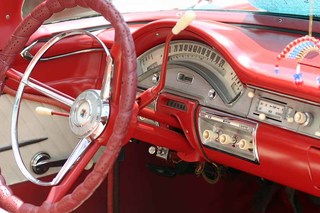 |
| 3 on the Tree Note the skinny steering column, and the red lever with a white tip. That is the transmission lever, for shifting. |
There
was a key to turn, then a button on the floor that the driver pressed
with his foot to turn the starter and start the car. While doing
that, the driver also used the gas pedal to give the car the
right amount of gas to start. The engines could be notoriously
persnickity. What worked for one car, might not work for the next, so
there was much fluttering of toes on pedals to get it just right.
Flooding
occurred when the driver “pumped the gas” too much. That refers
to pressing up and down repeatedly on the gas pedal, another trick
that one needed to master to start the car, especially in cold
weather. If overdone, the bowl of the carburetor became full of gas
and the car wouldn't start. It wasn't hard to tell when that happened
because the smell of gas filled the interior of the car. The cure was waiting. After enough gasoline evaporated, the driver gave
the car another try.
The
light switch was on the dash, and the dimmer switch was a button on
the floor that the driver stepped on with her left foot. I remember
many times stomping around on the floor of the car, trying to find
that switch, while the oncoming car flashed its lights in annoyance.
Nothing
was mounted on the two levers attached to the steering column. The
shift lever was on the right, and the turn signal on the left.
Everything else was operated via buttons, switches and knobs on the dash.
Seat
belts weren't available on nearly any car until the 1960s. In 1965,
Congress mandated that seatbelt be available on all cars. The first
car we had that came with seatbelts was the 1963 Galaxie.
If cars
didn't come with an engine or hose heater, Dad installed them. The
heater plugged into an electrical outlet, and warmed up the engine itself. It
was either fitted into the engine block, or a hose that brought water
from the radiator to the engine. In the winter cars had electrical heater cords hanging
out by the grille. If you didn't have a heater, your car wouldn't
start in the winter.
| Egg Beater |
| Electric Clothing Iron |
Irons
for clothing were just switching from a solid, cast iron tool heated
on top of the stove, to electric irons. Those early electric irons
were notoriously unpredictable and likely to damage clothing.
| Wringer Washer |
| Wringer Mechanism |
The clothing fell into the rinse tub, filled with clear water, for the next step. After the clothing had been rinsed in that water, which, of course, became somewhat soapy, Mom sent it through the wringer again, to land in a basket. It was carried out to the clothes line and hung up. The water was not changed for every load, too much water used that way.
My
generation has moved from paper, pencils and pens, to small hand-held
computers which double as telephones and cameras. Tablet computers,
ever-faster phones, self-publishing, (Like this.), instant
communication, real-time everything, cameras everywhere, habitable
planets light-years away. It is great, exciting, a thrill-a-minute. I
can't wait for the next advance, probably just around the corner.
Perspective,
as I learned from Gramma, is a good thing. An awareness of the
technology of the ones who came before us teaches us greater
appreciation of all they accomplished. We are able to feel humilty,
knowing that even more will come after us. That is good. That is as
it should be.
As
always, technology is a tool. We decide how we will use it. I trust
you of the 21st century to use it well.

No comments:
Post a Comment